Tibet has three lakes that are formally recognized as sacred in the Tibetan Buddhist tradition: Yamdrok-tso in the south, Namtso in the north, and Manasarovar in the far west. Each holds a specific role in the religious geography of the plateau, and each is profoundly different from the others — in geology, in pilgrimage tradition, and in what it offers a visitor.
Our standard eight-day expedition includes Yamdrok. We add Namtso for guests on extended itineraries. Manasarovar requires a separate expedition into Western Tibet that we run on request. This article describes what each lake actually is and why the difference matters.
Yamdrok-tso
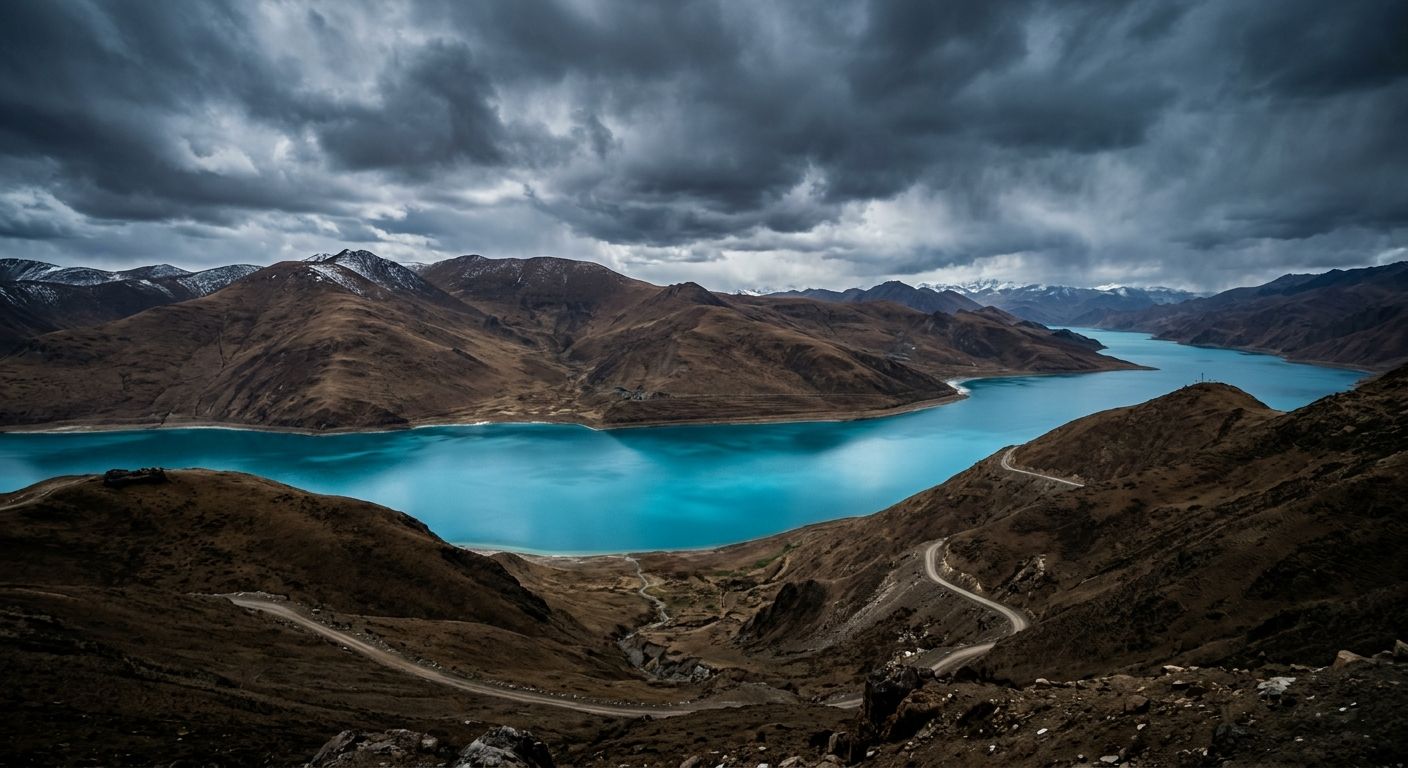
Yamdrok is the lake most visitors to central Tibet experience. It sits at 4,441 meters in Shannan Prefecture, southwest of Lhasa, and is shaped roughly like a scorpion when seen from the air. The shoreline is over 250 kilometers long. The water is, in the right light, the most extraordinary turquoise on earth.
The color is not painted. It is a function of glacial silt — fine particles of rock ground by ice over thousands of years, suspended in the water in low concentrations. These particles scatter blue and green wavelengths of sunlight while absorbing the warmer wavelengths. The result is a color that looks artificial because no other body of water at lower elevations produces it.
The sacred status of Yamdrok comes from its association with Dorje Phagmo, a female emanation of the bodhisattva Vajravarahi. The lake is said to be one of her terrestrial residences. The Samding Monastery, on a peninsula on the northern shore, has been led by a female reincarnate lama — the Samding Dorje Phagmo — since the fifteenth century. The current incarnation is the twelfth in the lineage.
What this means practically: Yamdrok is not just a beautiful lake. It is, for Tibetan pilgrims, a place where a specific feminine principle of awakening is locally present. Pilgrims circumambulate sections of the shoreline. They make small offerings. They do not generally swim, fish, or treat the water casually.
We respect this. Our private picnic location is selected to be beautiful but unobtrusive — far from any active pilgrimage route, away from the small villages on the shore. We do not allow drone photography over the lake itself.
A sacred lake is not a tourist attraction with religious decoration. It is a place where the religious tradition believes a specific awareness is available. Visitors who treat it that way often report something the casual tourist does not.
Namtso
Namtso is larger, higher, and structurally different from Yamdrok. It sits at 4,718 meters in northern Tibet, on the Changtang Plateau — an area that is mostly empty grassland, far from the agricultural belts of the south. The lake covers nearly 2,000 square kilometers and is the highest saline lake in the world.
The setting is austere. There is almost no vegetation around the shore. The Nyenchen Tanglha mountain range rises directly to the south, with peaks above 7,000 meters. The water is a deeper blue than Yamdrok — more cobalt than turquoise — because the silt content is lower and the depth is greater.
Namtso is sacred to a different tradition than Yamdrok. It is associated with the protector deity Damchen Dorje Lekpa. Pilgrims walk a circumambulation route around the entire lake, which takes approximately three weeks on foot. The route is dotted with small shrines, prayer flag clusters, and natural features (caves, rock formations, springs) that have specific religious significance.
We visit Namtso on extended itineraries — typically a two-night extension that adds Day 9 and Day 10 to the standard expedition. The drive from Lhasa is about five hours each way, which means a same-day visit is not realistic. The accommodation at Namtso is more rustic than what we maintain in central Tibet — heated yurt suites at a high-end camp, not five-star hotels — but the experience is dramatically different from Yamdrok.
What guests typically report: Yamdrok is breathtaking. Namtso is silencing. The two emotional registers are not the same.
Manasarovar
Manasarovar is the third sacred lake and the most difficult to reach. It sits at 4,590 meters in Ngari Prefecture, in the far west of the Tibet Autonomous Region, near the base of Mount Kailash. The combined Mount Kailash and Lake Manasarovar pilgrimage is one of the most significant in Asia — sacred to Buddhists, Hindus, Jains, and the indigenous Bön tradition.
The drive from Lhasa to Manasarovar is approximately 1,200 kilometers and takes four to five days each way. There is no airport closer than Ngari Gunsa, which has very limited domestic service. A full Manasarovar expedition is a minimum of fifteen days from Lhasa. We run these on request, typically once or twice per year for guests who specifically request it.
The lake is unusual geologically — it is one of the highest freshwater lakes in the world (most lakes at this elevation are saline due to evaporative concentration), and it sits beside Lake Rakshastal, a saline lake of similar size. The two lakes, just kilometers apart at the same elevation, with completely different chemistry, are both part of the sacred geography.
Manasarovar is sacred to multiple traditions for different reasons. For Hindus, it is the lake created by Brahma's mind. For Buddhists, it is associated with Anavatapta, a mythological lake at the center of the world. For Jains, it is connected to the first tirthankara, Rishabhadeva. The convergence of multiple religious traditions on this single body of water is unusual in world geography.
A Manasarovar expedition is a different product from our standard offering. The infrastructure is more rustic. The journey is longer. The altitude is sustained. We run it for guests who have already completed our standard expedition or who have substantial high-altitude experience.
Why Geography of Belief Matters
There is a tendency in luxury travel writing to treat sacred sites as spiritually generic — interchangeable backdrops for an unspecified "transformative experience." Tibet rewards the opposite approach. Each sacred site is sacred in a specific way, to specific traditions, with specific practices and prohibitions.
When our guests understand the difference between Yamdrok and Namtso — when they know that Yamdrok is associated with a female bodhisattva and Namtso with a protector deity, that the pilgrim circuits are different lengths, that the lakes are physically different colors for traceable geological reasons — they have a richer experience. They are not just at a beautiful lake. They are at a specific place with a specific meaning, and the specificity is what makes it feel real rather than performative.
Our guides — particularly Tenzin — are trained to share this depth without overwhelming guests. The rule is: explain enough to make the place coherent. Stop before it becomes a lecture.
For most guests, that means thirty seconds at the right moment, then silence to let the lake do the rest of the work.