The Tibet Reserve
JournalDepartures
Inquire Privately
Why Tibet Is the Last Frontier for Executive Travel
The DestinationMarch 2026·5 min read

Why Tibet Is the Last Frontier for Executive Travel

By Bob Wang

In an era where every luxury destination has been catalogued, reviewed, and Instagram-filtered into sameness, Tibet remains stubbornly, magnificently untouched.

In an era where every luxury destination has been catalogued, reviewed, and Instagram-filtered into sameness, Tibet remains stubbornly, magnificently untouched. This isn't an oversight. It's a feature.

The Tibetan Plateau sits at an average elevation of 4,500 meters — higher than most commercial aircraft cabins are pressurized. It is, quite literally, a different atmosphere. And that altitude acts as a natural filter. There are no cruise ships docking at Yamdrok Lake. No resort chains competing for beachfront. No influencers staging golden-hour content at Everest Base Camp.

01

The Infrastructure Problem That Became an Advantage

Tibet's remoteness has historically been framed as a limitation. Poor roads, limited hotels, unreliable connectivity. For mass tourism, these are dealbreakers. For the discerning executive who has already exhausted the Maldives, Patagonia, and the Norwegian fjords, they are precisely the point.

The Tibet Reserve was built on a contrarian thesis: that the world's most successful people don't want another five-star resort with a predictable infinity pool. They want to stand somewhere that challenges their internal model of what's possible.

02

How Tibet Compares to Its Nearest Peers

The comparison set is narrow. Bhutan, Nepal, and Patagonia are the destinations most often floated as alternatives, and each of them illustrates, by contrast, what Tibet actually is.

Bhutan is exquisite, but it is a curated kingdom — a tightly managed, daily-tariffed experience designed around a specific cultural narrative. The monasteries are immaculate and the valleys are green, but the scale is intimate. Tibet operates at a different order of magnitude: a plateau the size of Western Europe, sitting two kilometers higher than Thimphu, rimmed by the two highest mountain ranges on earth.

Nepal has Everest's south face and the Annapurna circuit, but it has also been thoroughly commercialized. Lukla's airstrip receives a constant rotation of flights during season. The Khumbu teahouse trail is, by any honest measure, a queue.

Patagonia is the closest analogue in terms of emptiness and raw geology, but its scale is horizontal — wind, ice, steppe. Tibet's scale is vertical. Standing on the plateau, the horizon itself is at 4,500 meters.

Most destinations offer a view. Tibet offers an altitude — a physical relocation of the observer.

04

The Psychological Return on Investment

We've observed something consistent across our guests — overwhelmingly C-suite executives, founders, and family office principals. The first two days in Tibet produce visible discomfort. Not from altitude (we manage that clinically), but from the absence of stimulation.

No notifications. No deal flow. No ambient noise of consequence.

By Day 3, something shifts. The executives who spend their lives making decisions at velocity begin to process at a different frequency. The Potala Palace doesn't care about your quarterly earnings. Yamdrok Lake doesn't respond to urgency. Everest has been standing there for 60 million years.

This isn't mindfulness tourism. It's a forced recalibration.

06

The Moments Guests Describe as Unreplicable

When we debrief guests at the end of an expedition, the moments they return to are strikingly consistent — and almost never the ones we expected to hear cited.

It is rarely the Potala Palace photographed head-on, which every guest has already seen in books. It is more often the light at 6:10 in the morning on the Barkhor, when pilgrims prostrate around the Jokhang and the only sound is wooden planks sliding across stone. It is the moment at Yamdrok Lake when the wind dies completely for ninety seconds and the turquoise surface becomes a second sky. It is the drive over the Gyatso La pass at 5,220 meters, where the road crests and the Himalaya — not a peak, but the entire range — appears simultaneously along the southern horizon.

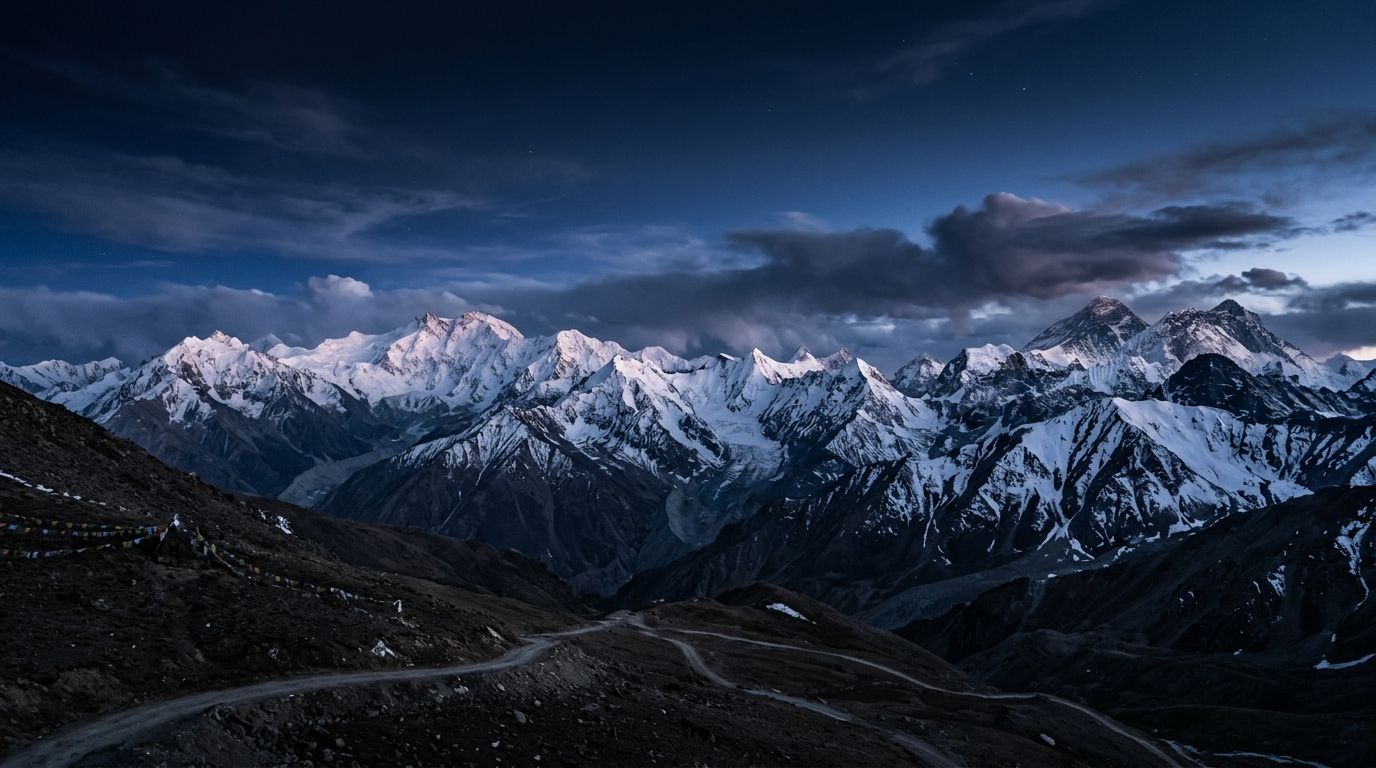
And it is, almost always, the first direct sight of Everest's north face from the Pang La pass at 5,248 meters. Guests stop speaking. They do not reach for a phone. They simply stand.

None of these moments can be staged. None can be replicated by a resort. None scale.

08

The Politics of Access

We operate within a permit regime that is more restrictive than any other tourism system we work with. This is simply the operational reality. The Tibet Autonomous Region requires specific authorizations — the Tibet Travel Permit, the Alien's Travel Permit, the Military Permit, and the Frontier Pass for border-adjacent areas like Everest — and none of these can be obtained by an individual traveler.

We take no political position on this. We are an operator. Our job is to hold every relevant license, to maintain the relationships that keep our approval rate effectively intact, and to make the bureaucratic apparatus invisible to our guests.

The practical consequence is worth understanding: the same restrictions that complicate access are the reason the plateau remains empty. A permit system that cannot be bypassed at the individual level is, functionally, a natural cap on visitor numbers. What looks like friction from the outside is what preserves the silence from the inside.

09

The Five-Year Window

Tibet's window of accessibility is narrowing. Infrastructure is improving — which sounds positive until you realize that improved infrastructure means more visitors, more development, and the gradual erosion of the very qualities that make the region extraordinary.

The Sichuan-Tibet Railway is under construction in phases and will, upon full completion, dramatically shorten travel times from the eastern gateways. The expanded expressway network west of Lhasa is already making the Friendship Highway corridor faster and more predictable. Gonggar Airport has added capacity. New hotel brands are quietly surveying land.

None of this is hypothetical. It is funded, scheduled, and moving.

We estimate a five-year window before the character of the destination shifts materially. Not because Tibet will become Nepal — the permit architecture prevents that outcome — but because the ratio of infrastructure to visitors is currently anomalous in the guest's favor, and that anomaly is closing.

The Tibet Reserve exists in a specific temporal window: after the roads became reliable enough for comfort, but before the destination becomes another item on every luxury travel agency's menu.

If you're reading this in 2026, that window is still open. Barely.

About the Author

BW

Bob Wang

Founder, The Tibet Reserve

Bob Wang is the founder of The Tibet Reserve. Over the past decade he has traveled the Tibetan Plateau more than forty times, building relationships with local operators, monastic communities, and permit authorities that make genuinely private expeditions possible. He writes from direct experience — not a desk.

Begin

Ready to experience this yourself?

Every expedition begins with a conversation. No commitment required.

Request a Private Consultation